
Blog #15 Introduction to: The Steady-State Population, (Blog 1 of 9 on Population)

In previous blogs I’ve declared the only way human beings can survive the next ten millennium is to maintain a healthy planet. I have also written the only way to maintain a healthy planet is to have far fewer humans than today. I’m certainly not the first to make this argument.
Malthus the Virtuous:
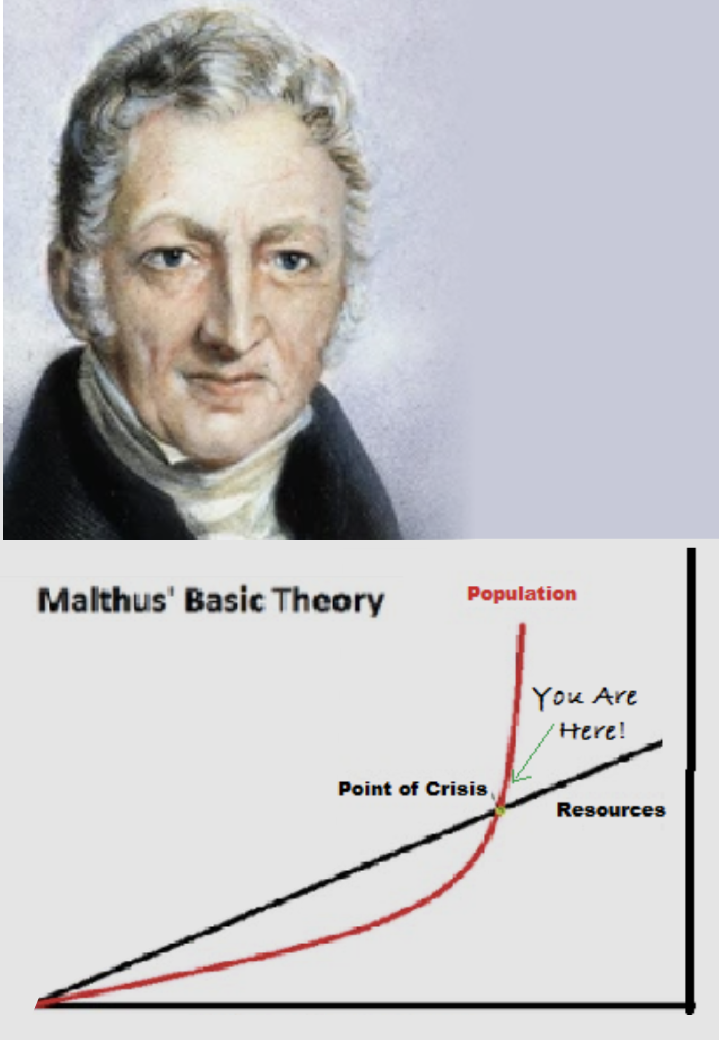
One of the early prophets pointing towards a need for a steady-state population was Thomas Malthus in the late 18th century. Malthus wrote; “The power of population is indefinitely greater than the power in the earth to produce subsistence for man.” A modern take on this is; as human’s ability to produce food increases, so does population, creating an ever-widening cycle until it crashes. It the mechanism that caused most societal collapses in the past.
As an Anglican cleric Malthus interpreted this situation as divinely imposed to teach virtuous behavior. In today’s terms I would hope that “virtuous behavior” could be viewed as understanding how our greatest strength, our intellect, has become our greatest threat, and that we must summon the will to redirect our mental abilities, and more problematically, our collective will, to solve the problem. Now this would be virtuous, but to work it requires the whole of a population, or most of it, plus its leadership, to accept it as a societal norm.
This redirection must first focus on changing whole population’s ingrained, subconscious belief that humans have dominance over the planet to an ethos of one where everybody understands we are only a part of it. Whatever forms our long-lasting steady-state civilization takes in the future, it must necessarily allow all the other lifeforms to exist, evolve and find their own natural balance again.
For if we learn anything about nature, it’s that the long-term health of any lifeform depends on the health of all the other lifeforms around it, from the microscopic to the gigantic.
As for when humans do dip into the well of natural resources to make our livings, we’ll learn to do it judiciously. It is as if we have been given stewardship of a garden, for the garden’s own sake, not ours. I don’t believe this means we have to give up our technologies and live as hippies or the Amish on the land.
On the contrary, as mentioned in Blog #11 on inventions, technology must progress and be used to allow and enhance a steady state population of some yet undetermined population number.
Having said this, let’s give a shout-out to those who have the courage of their convictions to live their lives simply, like those hippies, Amish and others.
They might be right, as many of my deep-ecology friends assert. But since them saying it or a tiny percentage of Earth’s population living “small” won’t change the fact that the vast majority of humans will undoubtedly go forward with the development and use of technology, I think my previously stated philosophy that human must use technology to keep our ecological footprint on the planet small, instead of using technology to increase it, is vital to increasing our chances of survival.
I am reminded of this every time I have a discussion with individuals who, although pleasant and unthreatening on their own, make decisions with their bankbook, religious texts, and short-term concerns for themselves and their families. I mean this statement without judgement or rancor, but just as fact. (well, maybe just a bit of judgement)


Latest Blogs
Blogs in Order
Blogs by Category
Join
Leave your comments...
0 Comments