
Blog #19
How few humans does there really need to be? (Blog 5 of 9 on Population)

Written by
Lory Kaufman

I have something for you to consider that I don’t think has been looked at this way before. It has to do with how few people are needed for humans to survive in the long run. What would be the lowest number of humans necessary to make sure we have enough genetic variation to remain healthy? I’m not going to pretend I know the scientific answer, but here’s what my curiosity and personal research has come up with.
To start, let’s look at a few examples of other large mammals. I cite only a few, but believe it’s adequate to make the point. Grazing animals, which become prey animals, such as the various breeds of elk presently number about 100,000, due to humans taking over their natural ranges.

However, historically their numbers were estimated to be 25 million. Deer, another prey animal, was estimated to be 200,000,000 in 1450, before Europeans came to North America. I would suggest the higher numbers for both could be considered natural for the purposes of keeping the species genetics varied enough for continuous healthy evolution, but low enough to exist regionally without stressing their ecospheres to the point of where their food supplies collapse over a wide range. Because they don’t have brains like ours, they are constrained by nature.

Now let’s look at one top predator, the African lion. Two and three thousand years ago it used to range all through Africa, the Middle East, southern Europe and even India and what is now Bangladesh. It is estimated there were well over 5 million lions and that it was the most prolific predator on the planet — after humans. Flash forward to the 1800’s and it’s estimated only 1.2 million of the beasts were around. By the 1940s, populations of them were around 400,000. 1950 saw an astounding drop to 100,000 lions. In the 1990s they were halved to only 50,000. And in the year 2000? Less than half, somewhere around 20,000.
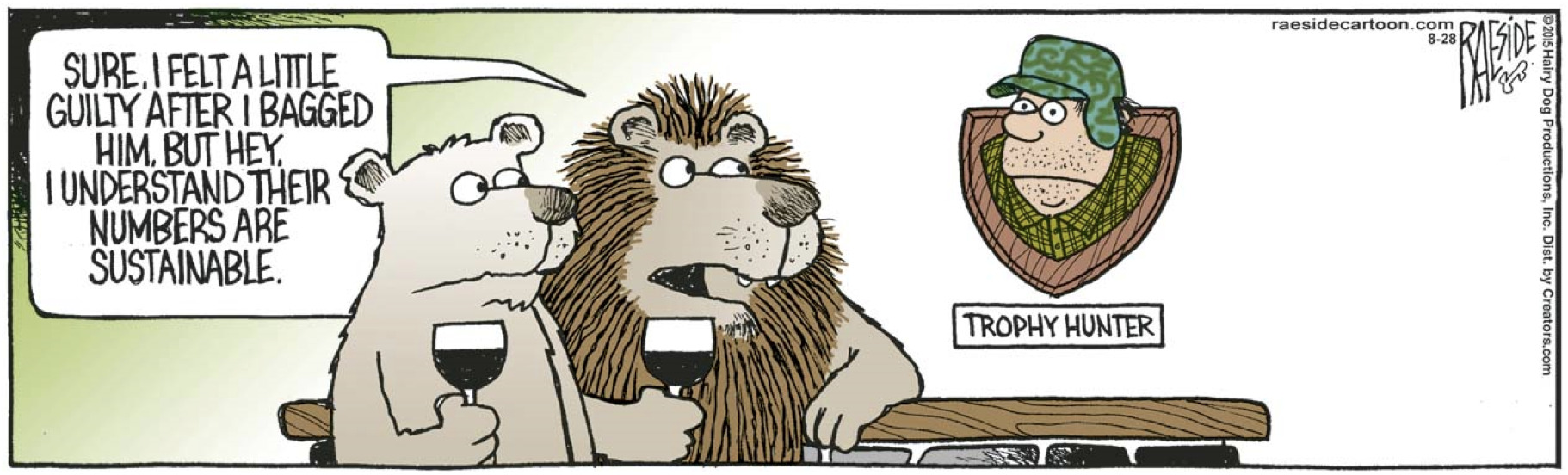
This means that in prehistoric times, without human interference, healthy populations of prey animals can exist in the low to mid hundreds-of-millions, while top predator animals (and that’s what we are) can have a healthy and diverse population in the very low millions. And that’s what our population was for the majority of our homo-sapiens existence. We don’t need billions or hundreds of millions to have a healthy and genetically diverse genetic base to help us move into the future. This is why I wrote earlier that our best minds would scientifically determine a number for an optimum human population of somewhere between 1 million and 1 BILLION

We must understand nature the best we can, including our own human natures, and learn from it all. Then, when there finally is an international consensus of how we must have a lower population, we will have the right information on hand to quickly pick a world-wide population number — and design a way to get to it.

And yes, I personally believe that we will have to choose a target number and not leave it to chance. Leaving it to chance will allow regional interests to make exceptions for various cultural and religious regions, usually to give power to a select few.

Perhaps humans may be able to have a slightly larger long-term population than other species because humans, with our sentient thinking, can possibly develop best practices that mitigate our overuse of the biosphere. (the opposite of what we do now) This would include and necessitate the use of technology to help keep our ecological footprint small, not expand it. On this one point, I believe the extreme right will agree with me, while my deep ecologist friends will not. (I love irony.) Well, we need to leave the real answers to science. The best I can do is pose a possibility and help try to formulate the right questions. Because when you spend your time formulating the question, when it’s finally clear, the answer becomes obvious.
Latest Blogs
Blogs in Order
Blogs by Category

Join

Leave your comments...


0 Comments

Submit a Comment

Your email address will not be published. Required fields are marked *