
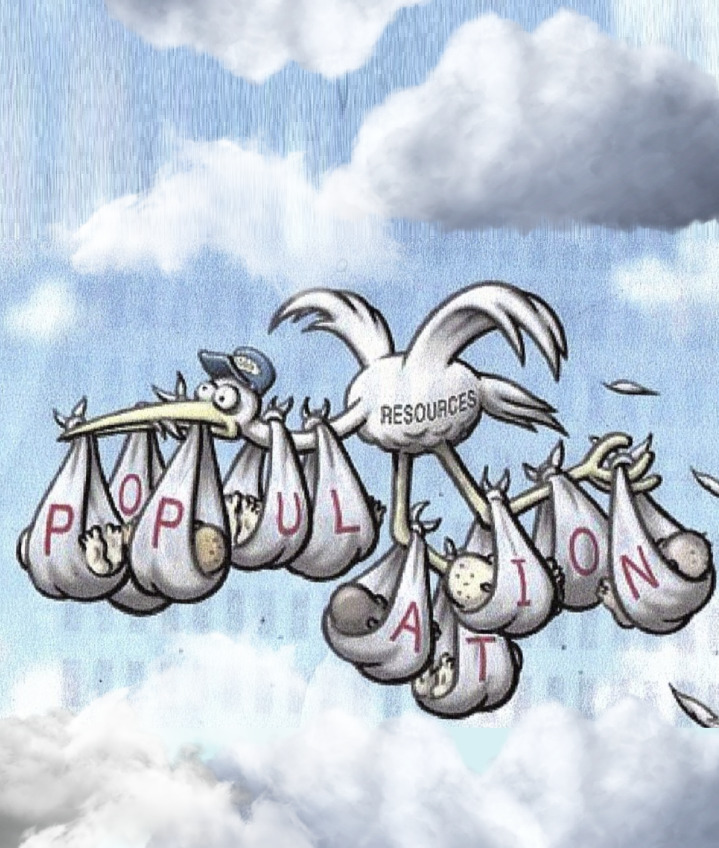
Blog #20 Population Dynamics – Total Fertility Rates and Replacement Rates: (Blog 6 of 9 on Population)

In developing countries the TFR is usually found to be significantly higher than in developed countries. This is for a number of reasons. People traditionally have many children because most don’t survive to adulthood and parents depend on adult children to look after them in their old age. It’s human history’s social-safety net. This trend continues where political and religious oppression generally keeps populations uneducated and less affluent. The reverse is true in more developed countries where stable incomes, healthcare, old age pensions, education for both men and women, unemployment insurance and, in general, opportunity, cause populations to think differently about the need for large families. This leads to much lower TFRs.
Then there is something called a Replacement Rate, which is the number of births needed to keep the population at the existing level. In most developed countries, where the vast majority of babies survive childhood, the replacement rate is around a TFR of 2.075. In developing countries the replacement rate, because of infant mortality, is found to be between 2.5 and 3.3. Worldwide, the average replacement rate requires a TFR of just over 2.3.
Feel the pain of others!
Think about this for a moment. If you are a parent living in a developed country, you know how hard it is to raise children. Now put yourself in the place of a person in a very poor country, where it is vastly more difficult to get the resources needed to raise a child. But yet, on average, parents in these societies must bury at least one child and often more. I mention this here because statistics make situations sterile and even boring. Readers might find their eyes glossing over. But the difference between a TFR of 2.075 children as a replacement number as opposed to a TFR of 2.5 and 3.3 means a daily grinding struggle for millions of parents trying to raise children. And now try to imagine the grief a parent in one of these countries feel because of their beloved offspring’s death.
The reality is, on this planet, right now, about A THOUSAND CHILDRED A DAY DIE IN DEVELOPING COUNTRIES.
Of course, if there was a worldwide steady-state economy, which ensures income and healthcare for everyone on the planet, it would mean that, when fully implemented, mothers and children would almost always survive, so the replacement rate could be an even two. However, that is not our goal. We need to reduce the population, and to do that we need a negative growth rate for a few centuries. But here’s a surprise. It is not that hard to accomplish. In fact, it’s already happening in most countries where there’s either adequate social services or at least a consistent attempt at it.
Of the world’s 224 countries, principalities, territories, city states and dependencies listed in the 2016 Central Intelligence Agencies World Fact Book, the Total Fertility Rate ranges between a high of 6.62 in Niger, Africa (well over six children per woman), to a low of 0.82 in Singapore, Asia. (less than one child per woman) On the complete list there are two countries above a TFR of 6, twelve in the low to high 5 range, twenty-two in the 4 averages, seventeen in the 3 range, sixty-four in the 2 range, one hundred and nineteen in the high to low 1s, and two below a TFR of 1.
As for TFRs falling, since the mid-20th century the fertility rate has dropped drastically. Between 1950 and 1955, when I was born, the average world TFR was 4.95. This was a surprise to me. But then, between 2010 and 2015, it dropped to 2.36.
And as mentioned, just two years later, the average world TFR is 2.3. It’s fallen 50% in 60 years.


Latest Blogs
Blogs in Order
Blogs by Category
Join
Leave your comments...
0 Comments